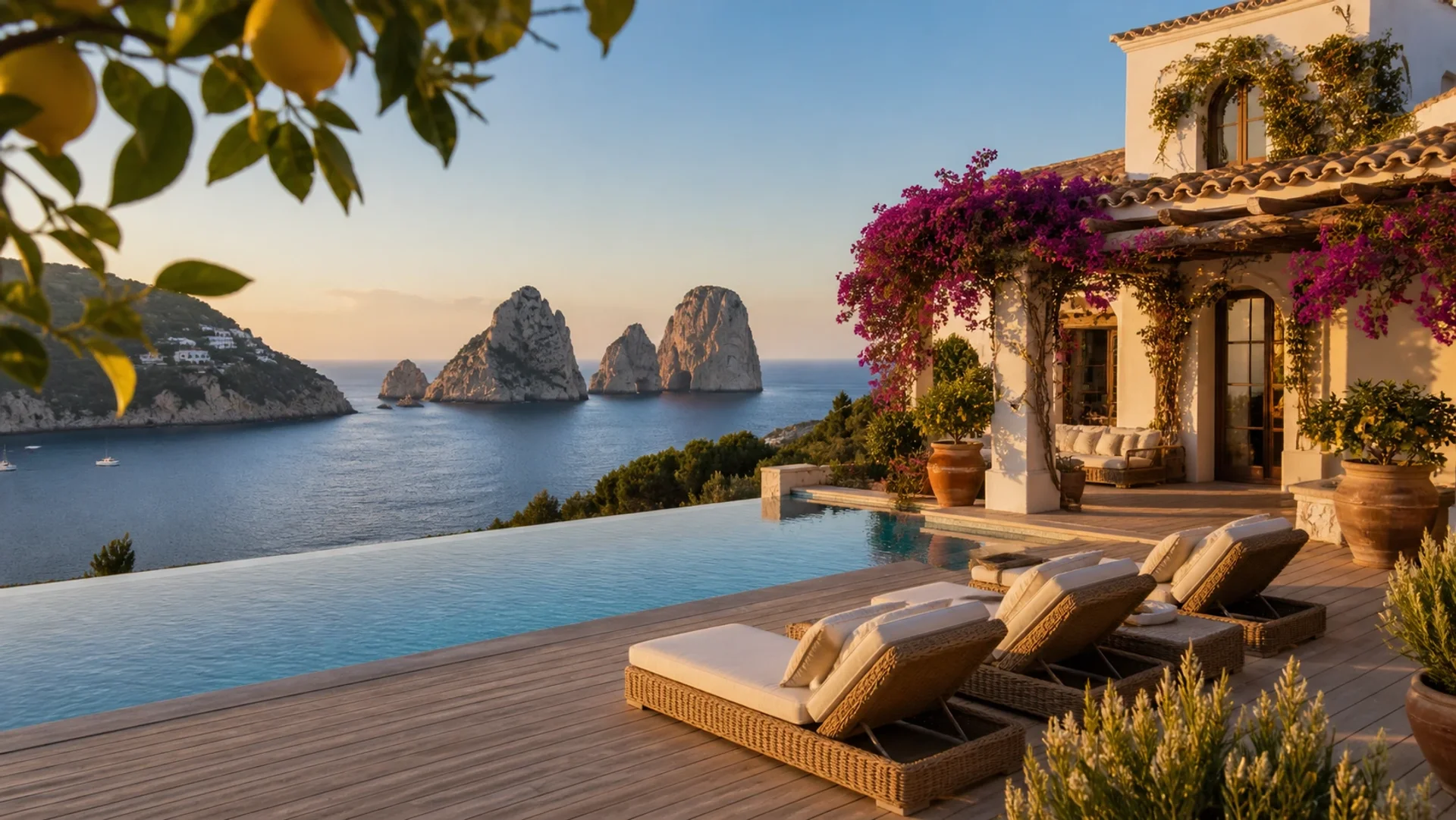
Italy · Mediterranean
Custom Bali Furniture for Capri
Produced in the workshop in Kerobokan, Bali, and shipped door to door by the workshop and its freight forwarders. Typical ocean transit of 25 to 35 days.
Italy, Mediterranean
The market
Capri is among the Mediterranean's most iconic luxury destinations. The 10-square-kilometer island hosts approximately 30 luxury hotel properties (Grand Hotel Quisisana, Capri Palace, Punta Tragara, Hotel Caesar Augustus) and several hundred private villas concentrated in Capri town and Anacapri. The market has been a destination for European nobility and luxury tourism since the 19th century, with deeply established design language emphasising white-and-blue Mediterranean aesthetic, traditional Italian craft, and natural materials. Furniture procurement is highly bespoke, often through Naples or Milan-based designers, with strong demand for materials that align with the island's traditional aesthetic while delivering modern performance.
Shipping & logistics
From Bali to Capri, the practical details.
- Typical transit time
- 25 to 35 days
- Departure port
- Benoa, Bali
- Arrival port
- Naples (Napoli), Italy
- Standard incoterms
- CIF Naples with onward delivery
- Furniture import duty
- 0% on most solid wood furniture (standard EU rates); rattan and bamboo categories up to 5.6%, confirmed by HS classification before shipment
- VAT / local tax
- 22% Italian IVA applies on duty-inclusive value
Direct services from Benoa to Naples operate via Suez Canal routing, typically 25 to 35 days transit. Naples is the primary container port for southern Italy. From Naples, inter-island ferry to Capri's Marina Grande operates multiple times daily, typically adding 1 day for cargo transit. Capri's Marina Grande has limited container capacity, so larger shipments may require partial unloading at Naples and final-mile transit via smaller vessels. Final on-island delivery to specific villa addresses typically uses small vehicles or porters given Capri's narrow medieval streets.
Customs & import notes
Italy operates as an EU member state, so EU customs procedures apply. Furniture imported from Indonesia enters the EU at standard EU rates determined by HS classification. Most solid wood furniture under chapter 94 (HS 9403.60 and neighbouring lines) enters at 0% duty; rattan and bamboo categories (HS 9403.82, 9403.83) can carry up to 5.6%. HS classification is confirmed before each shipment. The EU-Indonesia trade agreement (CEPA) is expected to remove remaining duties on Indonesian furniture once in force; the agreement was concluded in September 2025 and is not yet signed, and its entry into force is targeted for January 1, 2027. Standard 22% Italian IVA applies on the duty-inclusive landed value. Wooden furniture from Indonesia needs a FLEGT licence, issued on the Indonesian SVLK timber legality system; rattan and bamboo pieces are outside the scheme. From December 30, 2026, the EU Deforestation Regulation also applies to wooden furniture: the operator placing it on the EU market files a due diligence statement with the geolocation of the plots where the wood grew. Capri's narrow streets and limited vehicle access can complicate final-mile delivery; the freight forwarder plans villa access.
Climate considerations
Mediterranean, hot dry summers (28 to 32°C) and mild wet winters (12 to 16°C), with a microclimate slightly milder than mainland Naples.
- Mediterranean climate, hot dry summers (28 to 32°C) and mild wet winters (12 to 16°C)
- UV index 9 to 10 in summer, 4 to 6 in winter
- Salt-air exposure on north-facing villas is moderate; south-facing villas have lower exposure
- Capri's microclimate provides slightly milder conditions than mainland Naples
Recommended materials for Capri
A-Grade Plantation Teak (Mediterranean outdoor)
Teak is the primary outdoor material for Capri villas: pool decks, terrace dining, beach club furniture (where applicable). Capri's intense summer UV (9 to 10 UV index in July to August) and salt air from continuous Mediterranean exposure are handled by teak's natural oil content without chemical preservation. The silver-grey weathered patina typically developing within 18 months is often the preferred aesthetic for Capri properties.
Reclaimed Teak (statement pieces)
Reclaimed teak's heritage character aligns deeply with Capri's traditional aesthetic, where authentic age and provenance are valued more than pristine newness. Statement dining tables, custom bar fronts, lobby feature walls, library shelving for both private villas and boutique hotel renovation projects.
Natural Rattan (covered outdoor & indoor)
Rattan suits Capri's covered terrace and indoor applications well. Lounge seating, partition screens, hanging chairs in shaded courtyards and ground-floor terraces. The traditional Mediterranean design language has historical use of natural fibres, where Indonesian rattan provides modern manufacturing consistency at hotel-project scale.
Why Balinese furniture works for Capri
Capri’s traditional Mediterranean design language (white walls, terracotta, natural wood, blue accents) integrates beautifully with Indonesian teak and reclaimed timber. The island’s villa renovation market often specifies materials that age gracefully, where teak’s silver-grey patina and reclaimed teak’s heritage character provide exactly the time-worn quality that Capri’s design culture values.
Final-mile delivery on Capri requires small vehicles or porters given the island’s narrow medieval streets. The freight forwarder plans villa access, particularly for properties in upper Capri town or Anacapri where vehicle access is restricted.
What a typical Capri hospitality project would include
Illustrative example. A Capri hospitality project is shaped by the island’s small size and access constraints. A boutique hotel commission at the Capri Palace, JK Place, or Hotel Caesar Augustus tier (typically 30 to 50 keys) would include bedroom FF&E across all rooms, a signature restaurant fit-out, and terrace furniture, all sized to fit Capri’s narrow access. A private villa commission in Capri proper or Anacapri (4 to 8 bedrooms) would typically involve indoor dining and lounge, master and guest bedrooms, and shaded terrace pieces, with the entire scope often delivered in a single 20ft container that has been pre-broken into porter-sized loads at Marina Grande. Procurement is typically managed through a Naples or Milan-based interior designer.
Furniture considerations for Capri climate
Treat the island as a high-humidity microclimate, not a typical Mediterranean. Capri sits in a cooler, more humid pocket than mainland Naples. Summer humidity regularly exceeds 70%, particularly in shaded courtyards and ground-floor rooms. Pre-shipping humidity cure (acclimatising teak in conditions matched to Capri before container loading) reduces the risk of joinery shrinkage in winter and swelling in summer.
Avoid untreated natural rattan and unsealed cane. Capri’s combined winter humidity and summer salt cycles will typically degrade unsealed natural rattan within 2 to 3 winters. The material continually absorbs and releases moisture, loosening woven joints. Use UV-coated rattan for any semi-outdoor placement, and seal interior rattan with a moisture-resistant lacquer.
Specify salt-resistant finishes throughout, not just on the terrace. Capri’s compactness means even inland villas sit within 500 metres of salt-laden onshore winds. Lacquered brass, marine-grade stainless steel hinges, and powder-coated steel substructures hold up across the island. Raw iron and lower-grade plated hardware do not.
Buyer checklist for Capri projects
- Confirm maximum piece dimensions for porter access before sign-off. Capri town’s narrow medieval streets, plus stair access at most villas, mean pieces wider than approximately 90 cm or longer than 220 cm may require disassembly or alternative routing.
- Book the Marina Grande port slot in advance and confirm whether your shipment needs a partial unload at Naples. The Marina Grande port has limited container capacity, and larger orders typically transit via smaller vessels.
- Coordinate the delivery window with hotel concierge or villa caretaker. Vehicles are restricted in Capri town, and the porter or funicular leg requires staff on-site to direct placement.
- Plan for Anacapri’s narrow Via Provinciale access. Even where small vehicles are permitted, road clearance is tight enough to require careful piece sequencing.
- Pre-ship a dimensional dry run with the freight forwarder handling the final mile. Many Capri commissions only discover access problems on the day of delivery, a paper walk-through eliminates almost all surprises.
Questions
Frequently asked questions
How long does it take to get custom furniture from Bali to Capri?
Typically 12 to 20 weeks door to door depending on destination, including 8 to 10 weeks of production in the workshop in Bali. These are the workshop's typical lead times, not a commitment from Ubud Atelier. Containers from Benoa typically reach Naples in 25 to 35 days; the ferry to Marina Grande on Capri typically adds 1 day.
What import duty applies to wooden furniture in Capri?
Wooden furniture shipped to Capri, including seats with wooden frames, enters at 0% customs duty. Rattan and bamboo furniture carries 5.6%, cut to 0% for Indonesian origin under the EU GSP until December 31, 2026; Indonesia leaves the GSP on January 1, 2027. These are standard EU rates, set by HS classification.
Is VAT due on furniture imported into Capri, and at what rate?
Yes. Italy charges 22% import VAT (IVA) at customs on furniture shipped to Capri, calculated on the customs value plus duty plus transport to the place of destination in the EU. A VAT-registered business recovers it through its return. An indicative customs cost estimate can be prepared at quotation stage.
Which documents are needed to import furniture from Indonesia into Capri?
Wooden furniture for Capri needs a FLEGT licence, issued on the Indonesian SVLK timber legality system; rattan and bamboo pieces are outside the scheme. From December 30, 2026, the EU Deforestation Regulation also applies to wooden furniture: the operator placing it on the EU market files a due diligence statement with the geolocation of the plots where the wood grew.
Who handles shipping and customs clearance from Bali to Capri?
The workshop and its freight forwarder. The forwarder works with customs brokers at Naples and plans villa access on Capri. HS classification is confirmed with the freight forwarder before each shipment leaves Bali. Ubud Atelier's role is to introduce the project to the workshop and relay information to the client.
Is solid teak suitable for a hotel or villa in Capri?
Yes. A-grade plantation teak suits Capri terraces and pool decks: its natural oils and silica resist moisture and salt air without chemical treatment. Untreated, it typically develops a silver-grey patina within 18 months; teak oil keeps the golden tone. In Capri's humid microclimate, rattan needs a UV coating outdoors and a moisture-resistant lacquer indoors.
What is the minimum project size for a hotel or villa in Capri?
Hospitality projects in Capri, from a boutique hotel to a villa rental in Anacapri, start from €25,000. A private residence, such as an owner's own villa, starts from €10,000.
How does furniture reach a villa on Capri given the island's access constraints?
Marina Grande on Capri has limited container capacity, so larger shipments may be partly unloaded at Naples and moved on smaller vessels. On the island, small vehicles or porters cover the narrow streets, and pieces wider than approximately 90 cm or longer than 220 cm may require disassembly or alternative routing.
Figures checked: September 2026
Have a project in Capri?
Share the scope, timeline and destination. Ubud Atelier comes back with the workshop's capacity and lead time within 48 hours.