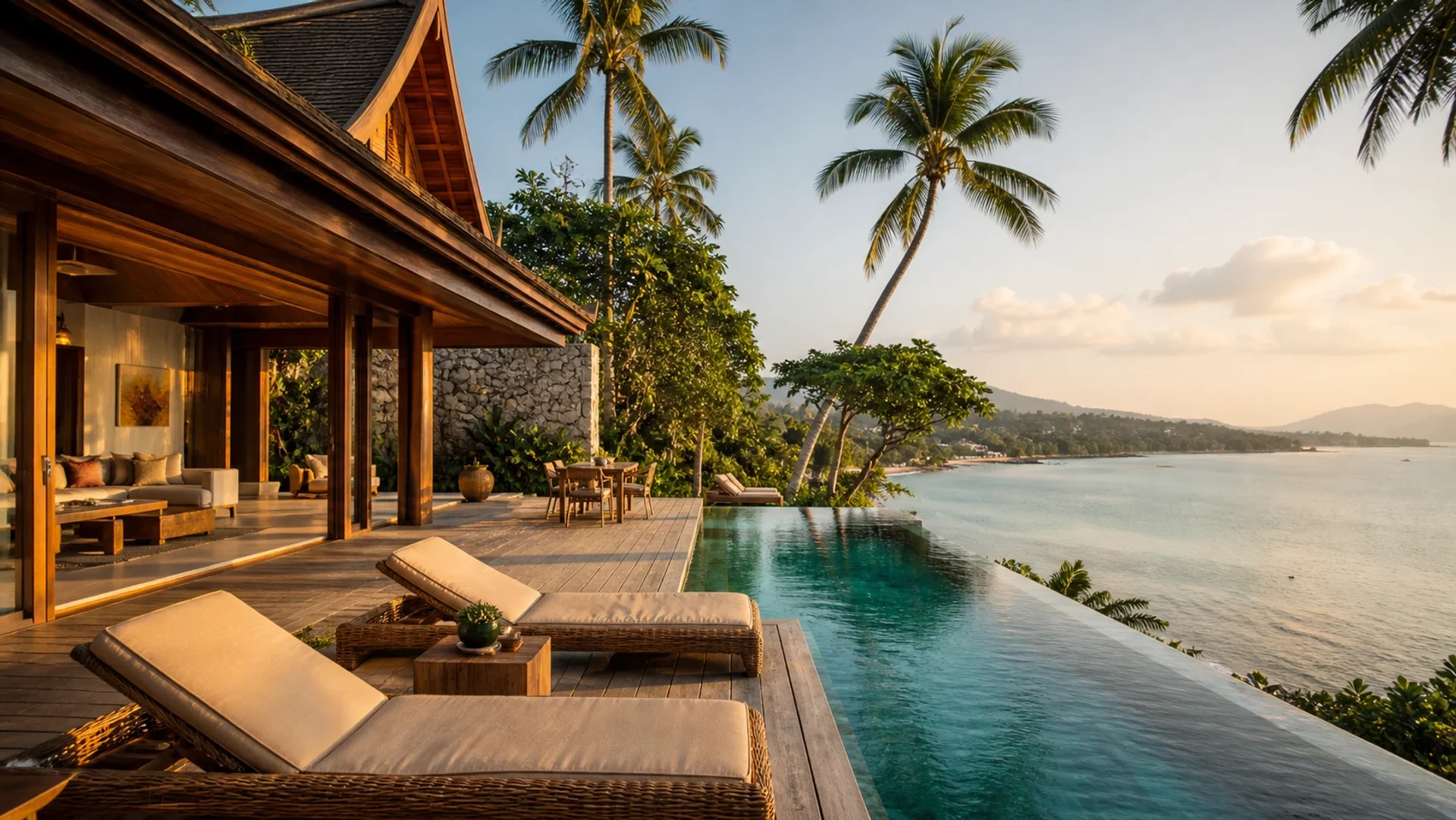
Thailand · Southeast Asia
Custom Bali Furniture for Koh Samui
Delivered door to door from our workshop in Kerobokan, Bali. 5 to 8 days transit.
Thailand, Southeast Asia
The market
The Thai luxury hospitality market is among Asia's most mature, with Koh Samui specifically positioning as a high-end alternative to Phuket since the 2010s. Banyan Tree, Six Senses, Four Seasons, and Conrad operate flagship properties on the island; Koh Samui hotel inventory has grown by approximately 40% over the past decade and continues to expand with new boutique villa developments along the western and northern coasts. The design specification across upper-tier Thai hospitality has converged on natural materials and indoor-outdoor living, where Balinese craftsmanship aligns naturally with Thai aesthetic preferences. Bali is one of the closest sourcing options for Thai resort developers, with one of the shortest transit times in the Ubud Atelier network.
Shipping & logistics
From Bali to Koh Samui, the practical details.
- Transit time
- 5 to 8 days
- Departure port
- Benoa, Bali
- Arrival port
- Laem Chabang Port, Thailand
- Standard incoterms
- CIF Laem Chabang
- Furniture import duty
- 0% under ASEAN AFTA (with Form D Certificate of Origin)
- VAT / local tax
- 7% Thailand VAT applies on the duty-inclusive value
Direct weekly services from Benoa to Laem Chabang are available across major carrier networks. Indonesia and Thailand are both ASEAN founding members, eligible for zero-duty treatment under the ASEAN Trade in Goods Agreement (ATIGA) provided a Form D Certificate of Origin accompanies the shipment. Koh Samui itself does not have a deep-water port, so containers transit through Laem Chabang and reach the island via barge or road-ferry combination.
Customs & import notes
Thailand customs duty for furniture sourced from Indonesia is 0% under the ASEAN Free Trade Area, conditional on presenting a valid Form D Certificate of Origin issued by the Indonesian Ministry of Trade. Without Form D, standard MFN duty rates of 20% apply, so chain-of-origin documentation is critical. Standard 7% VAT applies on the duty-inclusive landed value. SVLK timber legality certification is required for wood products, phytosanitary certificate may be required for natural fibre goods (rattan, bamboo).
Climate considerations
Tropical, hot and humid year-round (28 to 32°C), with high UV and a monsoon period October to December bringing elevated rainfall.
- Tropical conditions year-round at 28 to 32°C, monsoon October to December brings elevated rainfall
- UV index 10 to 12 throughout the year; covered outdoor applications strongly recommended for natural fibres
- Annual relative humidity 75 to 85%; well-cured Indonesian teak handles this without warping
- Salt air exposure on coastal properties is moderate; full marine-grade specification not required for protected coast applications
Recommended materials for Koh Samui
A-Grade Plantation Teak (indoor & shaded outdoor)
Teak performs exceptionally well in Thai conditions. Direct sun exposure on Koh Samui is moderated by the island's tropical canopy, and teak's natural silica content handles humidity and salt air without chemical treatment. For pool decks and beachfront terraces, A-grade teak with annual oil treatment retains its golden-brown finish; left untreated, it weathers to silver-grey within 18 months.
Natural Rattan (covered outdoor & indoor)
Rattan thrives in Thai climate when kept under cover. Lounge chairs, hanging seats, and partition screens for villas, restaurants, and beach club lounges are ideal applications. Avoid full direct sun exposure, prefer shaded terraces and covered verandas where rattan delivers 15 to 20 years of reliable performance.
Volcanic Stone (Paras), indoor
Paras stone provides a strong material complement to teak in indoor applications: statement dining tables, coffee tables, bathroom basins, and feature walls in Thai villa interiors. The material's heat absorption makes it less ideal for direct outdoor seated use in Thai summer, but it is excellent for AC-conditioned interiors.
Why Balinese furniture works for Thailand
The case for Bali sourcing in the Thai market is unique: it is the only major sourcing destination that combines true zero-duty access with proven craft traditions in tropical-grade timber and natural fibres. The Bali-to-Thailand route is the fastest in our network, 5 to 8 days transit, and the absence of customs duty under ASEAN AFTA means a 30-room villa project pays only the 7% Thai VAT on landed value, no incremental duty cost.
For a furniture order with a production value of $150,000, total Thai customs cost is approximately $10,500 (VAT only), compared to $30,000 or more for European-sourced equivalent furniture. The aesthetic alignment is strong as well: Thai resort developers consistently specify the natural teak and rattan finishes that define Balinese craft.
Thailand and Indonesia share equivalent tropical climate parameters, so material performance translates directly. A-grade plantation teak and properly cured rattan handle Thai conditions identically to Indonesian conditions, often better than European hardwoods which tend to crack or warp in tropical humidity.
What a typical Koh Samui hospitality project would include
A Koh Samui hospitality project would typically be either a boutique resort commission (40 to 80 keys at the Conrad, Six Senses, Four Seasons, Banyan Tree, or Cape Fahn scale) or a private villa commission (4 to 8 bedrooms on the northern and eastern coasts). Resort commissions on Chaweng Noi, Bophut, Maenam, and Choeng Mon would usually involve repeated bedroom FF&E, restaurant and bar fit-outs, and pool-deck pieces. The Bophut and Fisherman’s Village design-hotel cluster carries a tighter aesthetic vocabulary than the broader resort segment, with stronger demand for reclaimed and weathered finishes. Villa commissions across the northern and eastern coasts would scale to a single 20ft to 40ft container.
Furniture considerations for Koh Samui climate
Plan around the October-to-December monsoon, distinct from the Andaman calendar. Unlike Phuket and other Andaman destinations, Koh Samui’s heaviest rainfall and roughest sea conditions fall in October to December, with November typically the wettest. The dry window for outdoor installation is January to September, materially different from Andaman scheduling. Projects coordinated across both Thai coasts should not assume a unified monsoon calendar.
Engineer interior pieces against jungle-property mold and mildew pressure. Koh Samui’s interior northern and eastern coast villa belt sits in jungle and hillside microclimates with elevated humidity and limited natural airflow. Sealed joinery, ventilation-aware piece design (slatted seat decks, ventilated cushion wells), and pre-shipping humidity acclimatisation are durable defaults; enclosed cushion wells and unsealed joinery are recurring failure patterns in jungle properties.
Specify UV-stabilised and salt-resistant finishes for beachfront pieces on Chaweng Noi, Bophut, and Maenam. The eastern and northern coast beachfront properties face moderate salt loading and intense direct UV (10 to 12 index) year-round. Untreated rattan bleaches and softens within 1 to 2 seasons; unlacquered iron hardware corrodes within 12 to 18 months. Lacquered brass, marine-grade stainless, and sealed teak are baseline specifications for direct beachfront placement.
Buyer checklist for Koh Samui projects
- Plan ferry capacity to Koh Samui in advance. The Don Sak (mainland) to Nathon (Samui) car-ferry leg has limited capacity for full containers and may require multiple ferry voyages for larger orders.
- Sequence outdoor installation outside the October-to-December monsoon window where possible. The November peak is materially harder for jetty offloads and exposed-terrace work than the dry-season alternative.
- Confirm final-mile vehicle access for inland and hillside villa properties. Some interior coastal-belt properties are reached via narrow road access that requires smaller delivery vehicles.
- For high-volume orders, consider the Bangkok-via-Surat-Thani road haul plus ferry as an alternative to the direct Surat Thani routing. The choice has lead-time and ferry-capacity implications.
- Differentiate inland-jungle and beachfront piece specifications in the brief. The two microclimates carry distinct material requirements that should be locked at design stage.
Questions about Koh Samui delivery
Do I need to pay customs duty on furniture imported to Thailand from Bali?
No, provided you present a Form D Certificate of Origin under the ASEAN Free Trade Area. We handle Form D certification on every shipment by default. You'll only pay the 7% Thai VAT on the duty-inclusive landed value, no incremental import duty.
How does delivery to Koh Samui work, since the island has no deep-water port?
Containers arrive at Laem Chabang Port near Bangkok (5 to 8 days from Benoa). From there, our local logistics partners handle the road-and-ferry transit to Koh Samui (typically 24 to 48 additional hours) including final delivery and assembly at your property. Total door-to-door timing is 12 to 16 weeks from order confirmation.
Are Balinese teak and rattan suitable for the humid Thai climate?
Yes, they are exceptionally well-suited. Bali and Thailand share equivalent tropical climate parameters (humidity, temperature, salt air), so material performance translates directly. A-grade plantation teak and properly cured rattan handle Thai conditions identically to Indonesian conditions, often better than European hardwoods which tend to crack or warp in tropical humidity.
Do you work with Thai hospitality groups for multi-property orders?
Yes. Our logistics network serves both Thai islands and mainland properties, from boutique resort groups to large hospitality operators. Multi-property orders benefit from production economies of scale and consolidated container shipments. Contact us with your portfolio scope and we will provide a project plan.
Have a project in Koh Samui?
Tell us your scope, timeline and destination. We confirm logistics and capacity within 48 hours.